
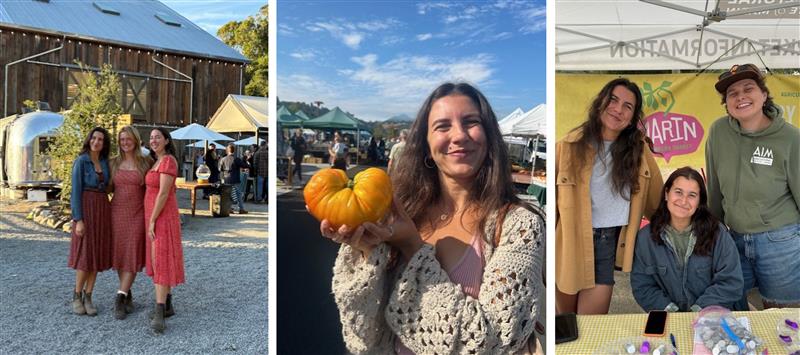
March is Women's History Month, and this year's theme: "Leading the Change: Women Shaping a Sustainable Future" couldn't be more fitting for our community. From vineyards to farms to food justice work, women are at the forefront of creating a more sustainable agricultural landscape. Today, we're thrilled to feature Darien Malekos, Director of Farmers Market Operations for Agricultural Institute of Marin (AIM).
What inspired you to pursue a career in farmers markets and community food systems?
I didn’t set out thinking, “I’m going to work in farmers markets.” In fact, like most folks, I didn’t even know being a Farmers Market Manager was a job. I just kept being drawn back to spaces where food, land, and community meet.
Farmers markets are one of the few places where you can stand face-to-face with the person growing your food. With this inevitably comes accountability, storytelling, and relationship building. Over time, I realized that these markets are so much more than sweet weekend outings. They are economic lifelines for small producers and powerful entry points for people to reconnect with their local food systems.
The idea that we can strengthen small farms, increase food access, and build community resilience all in the same space is what keeps me here.
What sustainability initiative are you most proud of?
I’m especially proud of the Zero Waste Fellowship Program we’ve built at AIM.
What started as a desire to reduce landfill waste has evolved into something much bigger as we rethink how our markets operate from the ground up. We are continuously implementing or improving upon our composting systems, edible food recovery programs, shopper and vendor education, and infrastructure that makes it easier and more accessible for both producers and consumers to make lower-waste choices.
The part I’m most proud of is the culture shift. Sustainability works best when it’s embedded into the rhythm of operations and shared by the whole community, not layered on as an afterthought. Our Zero Waste Fellowship Program is helping weave this mindset into our everyday operations, and I’m confident that foundation will continue to grow and strengthen in the years ahead.
How do farmers markets connect consumers to climate-smart agriculture?
Farmers markets make climate-smart agriculture visible. When consumers talk directly to farmers about soil health, crop rotations, water conservation, or why certain crops are thriving (or struggling) in a given season, climate stops being abstract and instead becomes tangible.
Markets also support diversified, smaller-scale operations that often rely on regenerative practices, shorter supply chains, and less packaging. By keeping dollars circulating locally and shortening the distance between farm and plate, we’re reducing emissions while strengthening regional resilience.
Connection drives change. When people know their farmers, they’re more invested in the long-term health of the land.
What advice would you give to women entering food systems work?
Food systems work is complex and can feel overwhelming. There are policy layers, economic pressures, climate realities, and community needs all intersecting at once. That being said, you don’t have to understand it all at once.
Lead with integrity, ask questions, and don’t underestimate the power of relational leadership. Some of the most impactful work I’ve seen has come from women who lead collaboratively, build trust, and hold both care and accountability at the same time.
Stay curious and remember: your voice belongs in the room.
What is your vision for the future of sustainable agriculture?
I hope we move toward an agricultural system that values soil health, farmer livelihoods, and community well-being as much as yield.
To me, that means investing in regenerative practices, strengthening regional food infrastructure, making healthy food accessible to more people, and ensuring that the farmers doing this work can thrive, not just survive.
I believe the future of sustainable agriculture is relational. It’s local and regional. It’s rooted in land stewardship and shared responsibility. And, it’s powered by collaboration with farmers, food businesses, nonprofits, policymakers, and consumers all playing their part.