

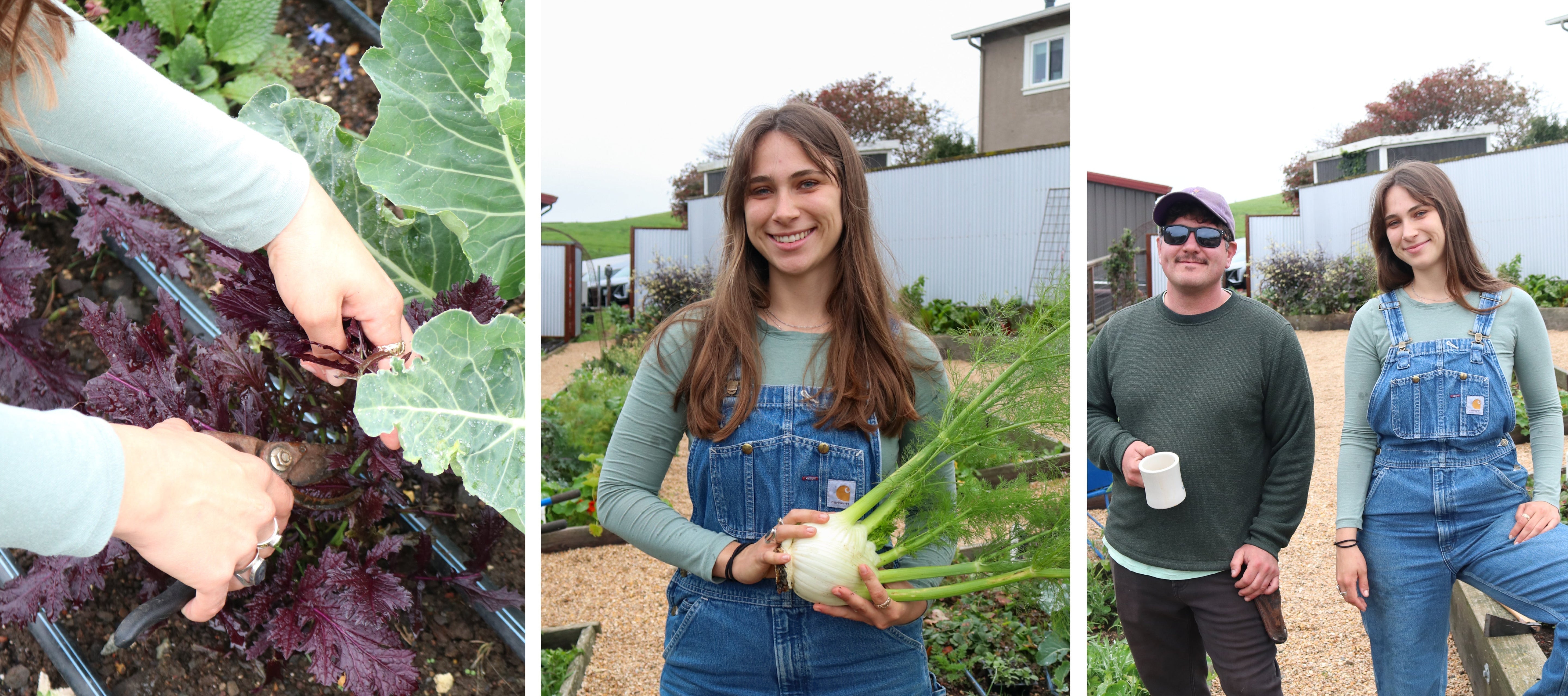
March is Women's History Month, and this year's theme: "Leading the Change: Women Shaping a Sustainable Future" couldn't be more fitting for our community. From vineyards to farms to food justice work, women are at the forefront of creating a more sustainable agricultural landscape. Today, we're thrilled to feature Taylor Jones, UC Davis Sustainable Agriculture class of 2025 & Point Reyes Farmstead employee.
What drew you to study sustainable agriculture and business at UC Davis, and how has that education shaped your vision for the future?
I chose to major in Sustainable Agriculture after taking an environmental history course at community college that fundamentally shifted my perspective on the world we live in. The class explored the commodification of natural resources in the United States and examined how systems of mass production and consumption have shaped our relationship with the environment. It prompted me to reflect on the kind of role I wanted to play in that system. I realized I did not want to contribute to a cycle of unchecked consumption, but instead work toward building more responsible and regenerative models.
That course helped me understand that meaningful change often begins with something as fundamental as the food we eat. It highlighted the importance of rebuilding the connection between consumers and the land, farmers, and processes that sustain them. This realization ultimately guided my decision to pursue Sustainable Agriculture at UC Davis, where I deepened my understanding of food systems and their broader social, economic, and environmental impacts.
Through my education, I have come to see food not only as nourishment, but as a powerful entry point for community engagement, environmental stewardship, and social equity. Looking ahead, I hope to educate and empower others around the principles of civic agriculture and the importance of knowing where their food comes from. By fostering awareness and connection, I believe we can create more resilient communities and a more sustainable food system.
What sustainable practice or innovation are you most excited to implement or see
implemented in agriculture?
Civic agriculture is a community based approach to farming in which local food systems are rooted in and sustained by the communities they serve. It prioritizes relationships between farmers and consumers, among local businesses. Rather than operating in isolation, civic agriculture strengthens local resilience by fostering collaboration.
During my year and a half working in Point Reyes, I have seen a compelling example of civic agriculture in practice. The level of community engagement is immediately evident. Local ranches, oyster farms, creameries, markets, and other food producers are in regular communication, often promoting one another and offering support when challenges arise. Instead of competing for limited markets, many of the local businesses operate with a shared understanding that their collective success strengthens the entire community.
What keeps you motivated and optimistic about the future of sustainable agriculture?
What keeps me motivated and optimistic about the future of sustainable agriculture is the strong commitment I witnessed among students pursuing fields of sustainable agriculture at UC Davis. I witnessed their dedication to learning, experimenting, and understanding agriculture from every angle reflects a deep desire to create meaningful change. As one of those students, I saw firsthand the passion and sense of responsibility the next generation brings to strengthening the global food system and advancing a more sustainable future.
Looking ahead, what's your vision for the future of sustainable agriculture, and what role do you see yourself playing in it?
My goal is to educate and inspire individuals to understand what it truly means to grow their own food and to recognize the importance of actively participating in the food systems that sustain them. We live in a time when many people are disconnected from the sources of their food, contributing to systemic challenges such as excessive food waste and a lack of awareness around production practices. I aim to address this disconnect by promoting the principles of civic agriculture and community engagement, encouraging individuals to view their own backyards as meaningful spaces for food production and local impact.
Who are the women (professors, farmers, entrepreneurs) who've inspired your journey so far?
The first woman who ultimately guided me toward majoring in sustainable agriculture was Justina Buller, a professor at Santa Barbara City College. I enrolled in her environmental history course, and her approach to teaching emphasizing both the historical context and the responsibility we hold in caring for our environment ignited a passion in me that shaped my academic path. Her ability to connect environmental stewardship with real world impact inspired me to pursue this field with purpose.
I also credit my mother, who gave me the freedom to choose a path aligned with my own interests and values rather than external expectations. From a young age, she immersed my sister and me in the outdoors gardening, hiking, and exploring local creeks. Those early experiences fostered a deep appreciation for the natural world and laid the foundation for my commitment to sustainable agriculture.